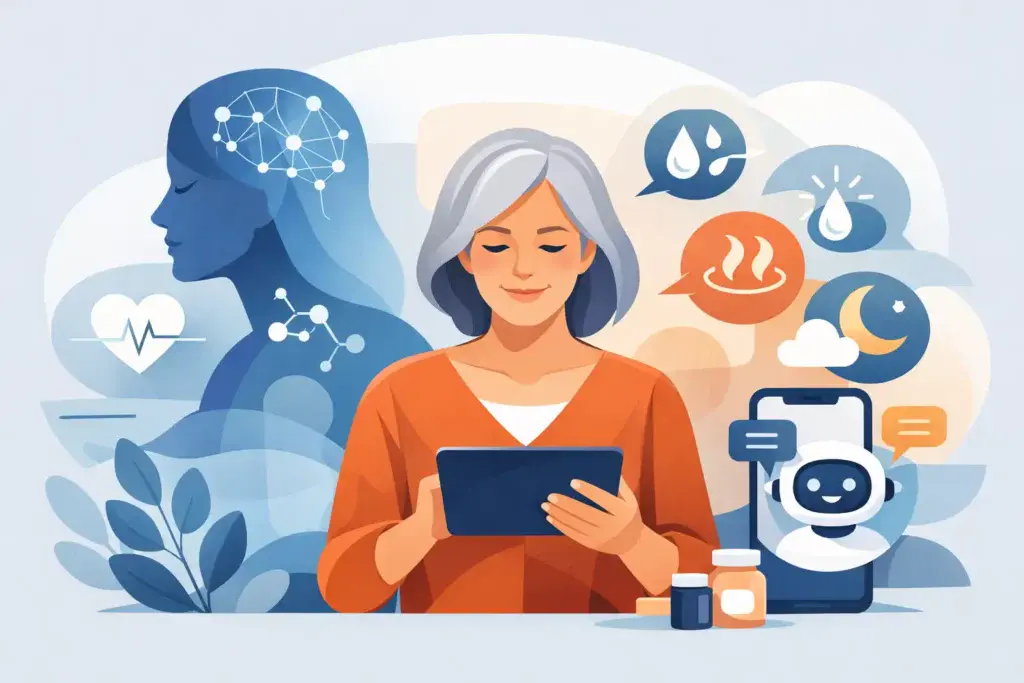
A 3 a.m. wake-up, a racing mind, another day of brain fog, and a cycle that no longer follows the rules can leave you wondering whether the pieces are connected. An AI menopause support tool can help bring those pieces into one place, turning scattered observations into clearer patterns and more useful questions for your healthcare provider. It cannot replace clinical care, but it may make it easier to feel prepared, informed, and believed.
You are not imagining it. Perimenopause and menopause can affect sleep, mood, energy, memory, temperature regulation, periods, and more. The challenge is that symptoms often shift from week to week, and the information women receive can feel fragmented. A thoughtfully designed digital tool can offer structure without adding another overwhelming task to your day.
What an AI Menopause Support Tool Is Designed to Do
At its best, an AI-based support tool acts like an organized, responsive wellness companion. You might log a hot flash, poor sleep, a skipped period, anxiety, or a new supplement. The tool can then help you notice potential patterns across time, translate your notes into plain language, and suggest topics to discuss at an upcoming appointment.
For example, it may reflect that sleep disruption appears to cluster around nights with night sweats, or that mood changes seem more frequent during a certain point in your cycle. That observation is not a diagnosis. It is a starting point for curiosity, tracking, and a more focused conversation with a qualified clinician.
This distinction matters. Menopause symptoms can overlap with thyroid conditions, depression, anemia, medication effects, sleep disorders, and other health concerns. AI can organize information, but it does not have your full medical history, physical exam, lab results, or clinical judgment. The goal is not to let technology tell you what is wrong. The goal is to help you arrive at care with a clearer record of what you have been experiencing.
Where AI Can Offer Real Day-to-Day Support
The most useful tools tend to support the ordinary moments that are easy to forget by the time an appointment arrives. A quick daily check-in can be more revealing than trying to reconstruct six months of symptoms from memory in a waiting room.
Symptom tracking that feels manageable
Many women do not need another exhaustive health log. They need a simple way to capture what changed, how intense it felt, and what else was happening that day. An AI tool may make this easier by letting you write naturally: “I woke up drenched in sweat twice and could not fall back asleep.” It can then categorize that entry alongside sleep disruption and night sweats.
Over time, a tracker may help you see frequency, severity, and possible triggers. You might notice that alcohol, stress, late meals, travel, or a warm bedroom seem to affect symptoms. Or you may find no obvious pattern at all. Both are useful findings, because they replace guesswork with a more accurate picture.
Clearer language for complicated experiences
It can be hard to describe brain fog, irritability, low motivation, or a feeling of being unlike yourself without worrying that you will sound vague or dismissed. AI can help turn personal notes into a concise symptom summary, using language that feels specific without making claims it cannot support.
That summary can be especially helpful before a doctor visit. Instead of saying, “I have not felt right lately,” you may be able to say, “For the past eight weeks, I have had sleep disruption four nights a week, frequent daytime fatigue, and increasing anxiety that is affecting work.” Specificity supports better conversations.
Practical education in the moment
A good tool can answer common educational questions in accessible language. It may explain the difference between perimenopause and menopause, describe why hormone fluctuations can affect sleep, or offer gentle ideas for preparing for an appointment.
Education should be evidence-oriented and honest about uncertainty. There is no single menopause experience, and there is no universal treatment plan. What helps one person may not be right for another, particularly if you have a history of certain cancers, blood clots, migraine with aura, liver disease, or take medications that affect treatment choices.
Appointment preparation and self-advocacy
One of the strongest uses for AI is helping you prepare rather than helping you self-diagnose. It can prompt you to gather relevant details: when symptoms began, whether your periods changed, what medications and supplements you use, how symptoms affect daily life, and what you hope to discuss.
It can also help you form direct questions, such as whether your symptoms could be related to perimenopause, what treatment options might fit your health history, or whether additional evaluation is appropriate. A well-prepared visit does not guarantee every answer, but it can help you take up space in the conversation with confidence.
What AI Should Not Do
The promise of personalization can sound appealing when you have spent months searching for clarity. Still, the safest AI menopause support tools have firm boundaries.
They should not diagnose menopause, prescribe medication, recommend starting or stopping hormone therapy, or minimize symptoms that need prompt medical attention. They also should not present generalized wellness information as personal medical advice.
Be especially cautious if a tool sounds certain about the cause of your symptoms based on a few entries. Menopause can be part of the picture, but it should not become an automatic explanation for everything. New chest pain, trouble breathing, fainting, sudden severe headache, one-sided weakness, heavy bleeding, thoughts of self-harm, or any symptom that feels urgent deserves timely medical attention, not a chatbot conversation.
Questions to Ask Before Using an AI Tool
Not every tool earns the same level of trust. Before sharing sensitive health information, take a moment to understand how it handles privacy and where its guidance comes from.
Look for clear, readable information about whether your data is stored, whether it is used to improve the product, and whether it may be shared with outside parties. You should be able to understand your options for deleting your information. If a privacy policy feels difficult to find or deliberately confusing, that is worth taking seriously.
Also consider the quality of the health content. Does the tool acknowledge limits? Does it encourage clinical care when appropriate? Does it explain that symptom patterns are not proof of a diagnosis? Responsible support is calm and transparent, not dramatic or overly confident.
Finally, choose a format you can actually sustain. A detailed dashboard may be useful for someone who enjoys data, while a two-minute daily journal may be better for someone already stretched thin. More tracking is not always better. Consistent, low-pressure tracking usually gives you more useful information than an ambitious system you stop using after three days.
Using AI as Part of Your Support System
Think of AI as one helpful layer in a larger support system. Your own observations matter. So do rest, nutrition, movement, mental health support, trusted relationships, and medical care tailored to your individual history.
For many women, the most meaningful benefit is not a perfect answer. It is the relief of seeing their experience organized in a way that makes sense. A symptom journal can become a record of change. A care summary can become a conversation starter. A thoughtful prompt can remind you that a difficult week deserves attention, not dismissal.
Novelle Journey is built around that kind of clarity: helping you gather the information, language, and confidence to navigate this chapter without carrying every question alone.
The right tool will not ask you to hand over your instincts. It will help you listen to them more closely, notice what your body has been communicating, and walk into your next care conversation with a steadier sense of what you need.
This article is for educational purposes only and is not medical advice. Always consult a qualified healthcare provider about your health.