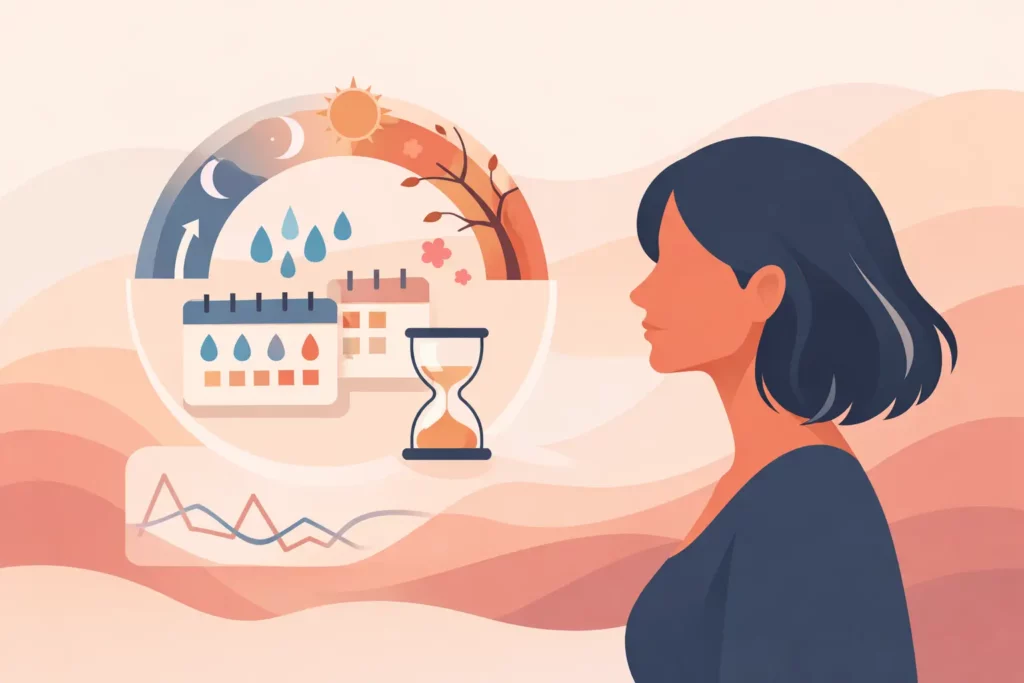
A period that suddenly arrives a week early. A cycle that stretches from 28 days to 40. Heavier bleeding one month, barely-there spotting the next. Cycle changes before menopause often begin this way – quietly, inconsistently, and just confusing enough to make you wonder whether what you are seeing is normal.
For many women, these shifts start during perimenopause, the transition leading up to menopause. This phase can last for several years, and your menstrual cycle is often one of the first places hormonal changes show up. If your pattern no longer looks like it used to, you are not imagining it. Your body may be giving you early signs that reproductive hormones are becoming less predictable.
Why do cycles change before menopause happens
The short version is that ovulation becomes less consistent. During the reproductive years, estrogen and progesterone rise and fall in a fairly reliable rhythm. As perimenopause begins, that rhythm can become uneven. Some cycles still include ovulation, some do not, and hormone levels may swing more dramatically than they used to.
That matters because your cycle depends on timing. When ovulation happens later than usual, your period may come later. When ovulation does not happen at all, bleeding may be delayed, lighter, or sometimes heavier after the uterine lining builds up longer than expected. This is why periods in perimenopause can feel erratic rather than steadily fading away.
Age can offer a clue, but it is not a rule. Some women notice changes in their late 30s. Others do not see a clear shift until their 40s. Genetics, smoking, certain medical conditions, and some treatments can all affect timing. There is no single age when this starts for everyone.
What cycle changes are common in perimenopause?
Common does not always mean comfortable, but it can help to know what often falls within the normal range. One of the most frequent changes is a shift in cycle length. A cycle that used to arrive every 28 days may begin coming every 24 days for a while, or every 35 days, or with no obvious pattern at all.
Flow can change, too. Some women notice heavier bleeding, especially in the earlier part of perimenopause, when estrogen can still be high but less balanced. Others notice lighter periods or more spotting between cycles. Clotting may become more noticeable. The number of bleeding days may shorten or stretch out.
You may also notice changes in symptoms around your cycle. Breast tenderness, sleep disruption, headaches, irritability, and PMS-like mood shifts can intensify or appear differently than they did before. That does not happen for everyone, but it is common enough that many women feel caught off guard by how familiar and unfamiliar their cycle feels at the same time.
Patterns women often notice
A typical pattern is shorter cycles at first, followed later by skipped periods or much longer gaps between them. Another is alternating heavy and light months. Some women also notice spotting before a full period begins or a sense that ovulation symptoms have become stronger or less predictable.
The key point is variability. Perimenopause is rarely a tidy, linear process.
When irregular bleeding is worth a closer look
There is a difference between the expected hormonal change and bleeding that should be evaluated. That line can feel hard to judge on your own, which is why tracking matters.
Talk with a healthcare provider if you are soaking through a pad or tampon every hour for several hours, bleeding for longer than about seven days regularly, bleeding after sex, bleeding between periods often, or going many months without a period and then having very heavy bleeding. It is also important to get checked if your periods have become so heavy that you feel dizzy, weak, or short of breath.
Fibroids, polyps, thyroid conditions, clotting disorders, medication effects, and changes in the uterine lining can all affect bleeding. Perimenopause is common, but it should not automatically become the explanation for everything. You deserve a careful look at what is going on.
Cycle changes before menopause versus menopause
This distinction matters because the words are often used interchangeably when they are not the same thing. Perimenopause is the transition phase. Menopause is a point in time, defined as 12 consecutive months without a menstrual period.
So if your cycle is still showing up, even irregularly, you have not reached menopause yet. You are likely in perimenopause if you are in the typical age range and noticing irregular periods along with symptoms such as hot flashes, sleep changes, mood changes, or vaginal dryness. Once you have gone a full year without bleeding, you have reached menopause and have moved into post menopause.
That is also why pregnancy is still possible during perimenopause if you are ovulating occasionally. If you do not want to become pregnant, birth control still matters until menopause is confirmed.
What tracking can tell you?
When your cycle stops behaving the way it always has, memory becomes unreliable fast. You may remember the worst month clearly and forget the rest. Tracking helps turn a vague sense of “something is off” into patterns you can actually use.
Keep it simple. Note the start and end date of each period, whether bleeding is light, moderate, or heavy, any spotting, and symptoms such as sleep trouble, mood shifts, headaches, breast tenderness, or hot flashes. It can also help to track stress, major changes in exercise, and illness because those can influence your cycle, too.
After two or three months, patterns often become easier to see. You may realize your cycles are getting shorter, that insomnia ramps up before bleeding starts, or that the heavy month tends to follow a skipped cycle. That kind of information can be reassuring for you and useful in a medical appointment.
For many women, the most valuable part of tracking is not perfection. It is clarity. A few consistent notes are more helpful than trying to capture everything.
How to talk with your doctor about changing cycles
If you have ever left an appointment feeling brushed off, preparation can make a real difference. Instead of saying, “My periods are weird,” try describing the pattern specifically. For example, “My cycle used to be every 29 days, and over the last six months it has ranged from 21 to 43 days,” or “I have had two episodes of bleeding so heavy I needed to change protection every hour.”
Bring a record of your cycle history, symptoms, medications, and any family history that feels relevant. If you are also having hot flashes, sleep disruption, anxiety, brain fog, or vaginal symptoms, mention those too. They help fill out the picture.
Depending on your age, symptoms, and health history, your clinician may discuss whether evaluation is needed for causes of abnormal bleeding. Sometimes that includes lab work, imaging, or an endometrial assessment. Sometimes the conversation centers more on symptom management and monitoring. It depends on the details.
What can help when cycle shifts affect daily life?
There is no one-size-fits-all answer, because some women mainly need reassurance while others need treatment. If heavy or painful periods are disrupting work, sleep, exercise, or day-to-day confidence, it is reasonable to ask about options.
Treatment may involve hormonal birth control, a hormonal IUD, other medications to reduce bleeding, or approaches that address related symptoms such as sleep or mood changes. If you have underlying issues like fibroids, treatment decisions may look different. Lifestyle support matters too, but it should not be used to minimize real symptoms that deserve care.
This is where a practical, organized approach helps. At Novelle Journey, the goal is to make those patterns easier to recognize so you can walk into conversations with more confidence and less second-guessing.
A changing cycle can still be a healthy signal
Not every irregular period is a problem, and not every difficult period should be ignored. That middle ground is where many women live during perimenopause. Your cycle may be changing because your hormones are changing. That can be normal, even when it feels unfamiliar.
If your body seems less predictable lately, try not to judge yourself for wanting answers. Paying attention is not overreacting. It is care. And often, the more clearly you can see the pattern, the easier it becomes to decide what needs reassurance, what needs support, and what needs a closer look.
This article is for educational purposes only and is not medical advice. Always consult a qualified healthcare provider about your health.