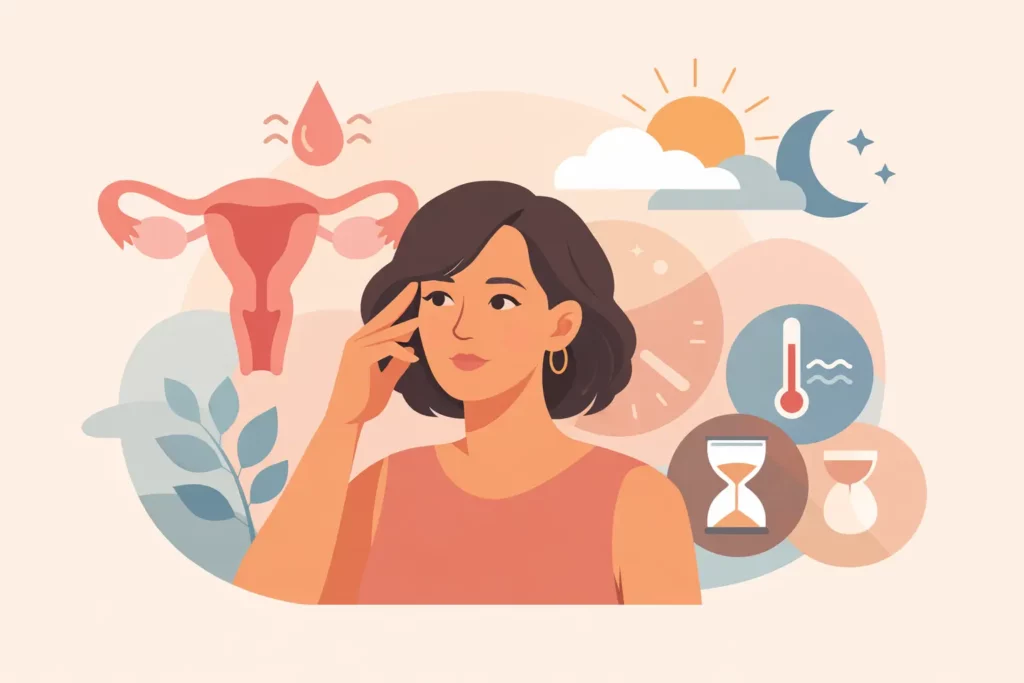
One month, your sleep is off, your period is suddenly early, and you feel strangely irritable for no clear reason. The next month, things seem normal again. If you have found yourself wondering what perimenopause is, you are not overreacting, and you are not imagining it. This stage can begin more subtly than many women expect, and the signs are often easy to dismiss at first.
Perimenopause is the transition leading up to menopause. During this time, your ovaries gradually produce less estrogen and progesterone, and those shifting hormone levels can affect your cycle, mood, sleep, energy, and more. Menopause itself is one point in time – when you have gone 12 months without a period. Perimenopause is the stretch of time before that point, and it can last for several years.
What is perimenopause, exactly?
A clear way to think about perimenopause is this: it is the hormonal transition between your reproductive years and menopause. Your body is not switching off overnight. Instead, hormone levels begin to fluctuate in ways that can feel unpredictable.
For many women, the first sign is a change in menstrual patterns. Periods may come closer together or farther apart, feel heavier or lighter, or become less predictable overall. But perimenopause is not only about periods. Because estrogen affects many systems in the body, changes can show up in sleep, body temperature regulation, mental clarity, and emotional steadiness too.
This is one reason the experience can feel confusing. You may notice symptoms that seem unrelated or that come and go. A few difficult weeks may be followed by a month that feels mostly fine. That uneven pattern is common.
When does perimenopause start?
Most women begin perimenopause sometime in their 40s, but it can start in the mid-to-late 30s for some and later for others. There is no single age that applies to everyone. Genetics, smoking, certain medical treatments, and individual health history can all influence timing.
The average age of menopause in the United States is around 51, and perimenopause often begins several years before that. Some women notice obvious changes early. Others only realize in hindsight that the transition had already started.
That uncertainty can be frustrating, especially if you are trying to decide whether what you are experiencing is stress, burnout, thyroid issues, a mental health concern, or hormonal change. Sometimes it is one thing. Sometimes it is a combination. That is why tracking patterns over time can be more useful than trying to interpret a single bad week.
Common symptoms of perimenopause
The symptoms of perimenopause vary widely. Some women have mild changes. Others feel as if their body has become unfamiliar. Both experiences are valid.
Irregular periods are one of the most common signs, but they are not the only one. You may also notice hot flashes, night sweats, sleep disruption, mood swings, anxiety, brain fog, fatigue, vaginal dryness, lower libido, headaches, or changes in weight and body composition. Some women also report joint discomfort, heart palpitations, breast tenderness, or a shorter fuse than usual.
Not every symptom is caused by perimenopause, and not every woman gets the same cluster of symptoms. That is where confusion often grows. If your sleep is poor, your mood and focus may worsen too. If your cycle becomes heavier, you may become iron deficient and feel more fatigued. Hormonal shifts can overlap with very real medical issues that deserve attention.
A calm, practical approach helps here. If symptoms are recurring, disruptive, or new for you, it is worth paying attention to them rather than brushing them aside.
Why perimenopause can feel so unpredictable
Perimenopause is often described as a hormonal roller coaster, and while that phrase gets overused, the basic idea is true. Estrogen does not simply decline in a straight line. It can rise and fall unevenly, which helps explain why symptoms may appear suddenly, disappear, and then return.
You might have one cycle that is completely normal and the next that is unusually heavy and late. You may sleep well for two weeks and then start waking at 3 a.m. every night. This inconsistency is part of what makes perimenopause hard to recognize and hard to explain to other people.
It can also affect confidence. When symptoms change from month to month, it is easy to second-guess yourself. Keeping a simple record of your cycle, sleep, mood, and physical symptoms can create the clarity that memory alone often cannot.
How long does perimenopause last?
Perimenopause often lasts around four years, but that is only an average. For some women, it is shorter. For others, it can last closer to eight years or more. The timeline depends on your individual biology and health history.
The transition ends once you have gone 12 consecutive months without a period. At that point, you are considered to have reached menopause. After that comes post menopause.
Because this phase can be long, support matters. Many women assume they just need to push through a few odd cycles, then feel discouraged when symptoms continue. Knowing that perimenopause can be a multiyear transition does not make it easy, but it can make the experience feel less random.
Can you still get pregnant during perimenopause?
Yes. As long as you are still ovulating, even irregularly, pregnancy is still possible. Fertility declines during perimenopause, but it does not disappear until menopause has occurred.
This is an important detail because irregular periods can create a false sense of certainty. If you do not want to become pregnant, birth control may still be necessary until you have reached menopause. If you do hope to conceive, it may help to talk with a healthcare provider early, since cycle changes can make timing less predictable.
How is perimenopause diagnosed?
Perimenopause is usually identified based on age, symptoms, and menstrual changes rather than one definitive lab test. Hormone levels can fluctuate so much during this stage that a single blood test may not give a reliable answer.
That does not mean testing is never helpful. Depending on your symptoms, a clinician may want to rule out other conditions such as thyroid disorders, iron deficiency, sleep disorders, depression, or other causes of abnormal bleeding. If your periods are very heavy, very frequent, stop suddenly at an unusually early age, or you have bleeding after sex or between periods, those are especially worth discussing.
If you feel dismissed, go in with specifics. Track when your period starts and stops, how heavy it is, whether you are waking at night, what mood changes you notice, and any symptoms that interfere with daily life. Clear patterns often lead to better conversations.
What can help during perimenopause?
There is no one-size-fits-all solution, because symptoms and health histories differ. What helps one woman may not be the right fit for another.
For some, the most helpful first step is simply understanding what perimenopause is and recognizing that symptoms can be connected. From there, lifestyle support may make a meaningful difference. Consistent sleep habits, strength training, protein intake, stress regulation, limited alcohol, and a symptom-tracking routine can help some women feel steadier.
Others may need more targeted care. Hormone therapy can be appropriate for some women, especially when symptoms are significantly affecting quality of life, but it is not the right option for everyone. Some women use nonhormonal medications, vaginal estrogen for dryness, therapy support for anxiety or mood changes, or treatment for specific concerns like migraines or heavy bleeding.
The goal is not to endure symptoms in silence. It is about understanding what is happening and finding support that matches your body, your risks, and your priorities.
When to talk with a doctor
Perimenopause is normal, but suffering through severe symptoms without support is not something you have to accept. If your sleep is consistently disrupted, your mood feels unlike yourself, your bleeding is unusually heavy, or you are struggling to function, it is reasonable to ask for help.
It is also worth checking in if symptoms start earlier than expected, if you have a history of depression or anxiety that is worsening, or if you are unsure whether what you are experiencing is hormonal at all. Perimenopause can overlap with other health conditions, and good care should make room for that complexity.
At Novelle Journey, this stage is viewed the way many women experience it in real life – not as a single symptom, but as a pattern that touches daily routines, emotional well-being, and confidence in your own body.
Perimenopause is a transition, not a personal failing. If your body feels different lately, that change deserves attention, language, and support. Clarity does not solve everything, but it can make the next step feel far less lonely.
This article is for educational purposes only and is not medical advice. Always consult a qualified healthcare provider about your health.