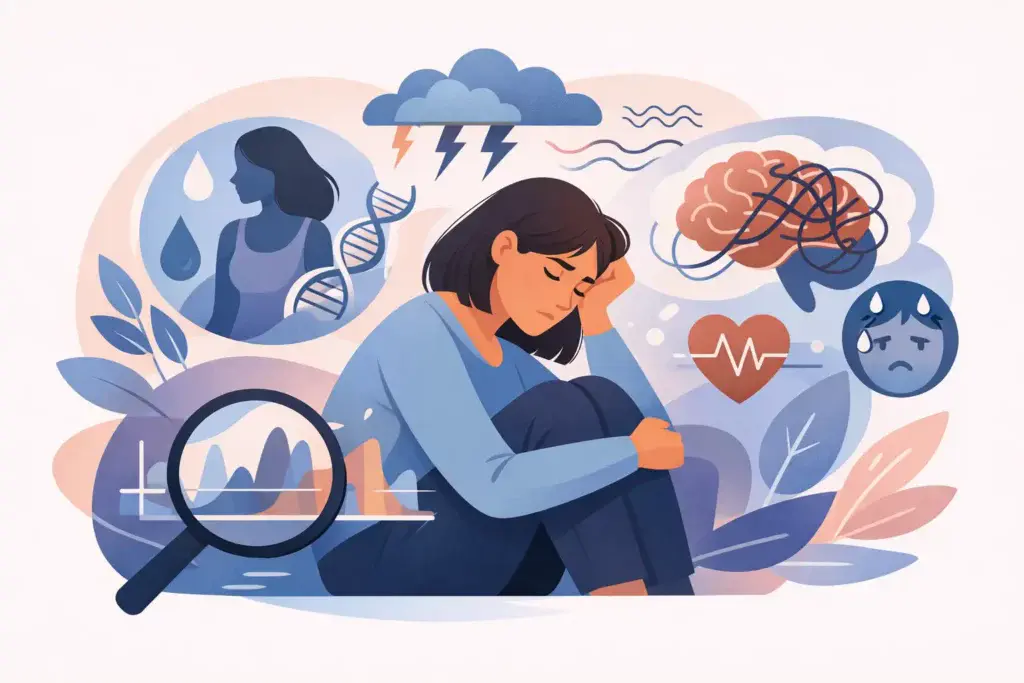
A rush of dread at 3 a.m. A suddenly racing heart during a routine meeting. Feeling unusually on edge before a period, then more like yourself a few days later. If you are wondering how to spot hormone related anxiety, these details matter. You are not imagining the shift, and you do not have to explain it away as simply “stress.”
Anxiety can become more noticeable during perimenopause and menopause, when estrogen and progesterone fluctuate and eventually decline. But hormones are rarely the only factor. Sleep loss, caregiving, work pressure, life changes, medication, thyroid conditions, and mental health history can all shape how anxiety feels. The goal is not to diagnose yourself. It is to recognize patterns, gather useful information, and get support that considers the full picture.
Why hormonal changes can affect anxiety
Estrogen does much more than influence the menstrual cycle. It interacts with brain chemicals involved in mood, stress response, and sleep. During perimenopause, estrogen may rise and fall unevenly rather than gradually declining. Those fluctuations can leave some women feeling emotionally steady one week and unusually tense, tearful, or unsettled the next.
Progesterone also plays a role. Its metabolites may have calming effects in the brain for some people. As ovulation becomes less predictable, progesterone patterns can change too. This does not mean every anxious feeling is caused by hormones. It does mean that a new or changing pattern of anxiety in your late 30s, 40s, or 50s deserves thoughtful attention.
Hot flashes and night sweats can add another layer. Waking hot, sweaty, and alert several times a night can make the nervous system feel frayed by morning. After enough disrupted nights, ordinary demands can feel harder to manage. In that situation, anxiety may be partly a direct symptom and partly a very understandable response to exhaustion.
How to spot hormone related anxiety through patterns
The clearest clue is often timing. Hormone-related anxiety may feel cyclical, fluctuating, or connected to other signs of perimenopause. You might notice it in the days before your period, around ovulation, after missed periods, or during stretches when your cycle becomes shorter, longer, heavier, or less predictable.
Look beyond the feeling of anxiety itself. Are you also having night sweats, hot flashes, sleep changes, brain fog, headaches, breast tenderness, heart palpitations, fatigue, joint aches, or changes in menstrual flow? A cluster of symptoms does not prove a hormonal cause, but it gives a healthcare professional more useful context than anxiety alone.
Hormone-related anxiety can look different from person to person. For some, it is a low, persistent sense of unease. For others, it arrives as irritability, sudden worry, a feeling of being overstimulated, or a panic-like surge without an obvious trigger. You may still be functioning at work and at home while feeling as though your internal bandwidth has narrowed dramatically.
It can also be helpful to notice what is new. Perhaps you have always been a worrier, but now your anxiety is stronger before your period. Or perhaps you have never struggled with anxiety and are surprised by physical sensations such as a pounding heart, chest tightness, trembling, or a sense of impending doom. New symptoms should be taken seriously without assuming the worst.
A pattern is more useful than a single difficult day
One rough night does not always reveal much. A simple symptom record over six to eight weeks can. Each day, note your cycle day or bleeding status, anxiety level, sleep quality, hot flashes or night sweats, caffeine and alcohol intake, major stressors, and any medication changes. A scale from 0 to 10 is enough.
Also write down what helped, even a little. Did a walk lower the intensity? Did anxiety spike after two glasses of wine or an afternoon coffee? Did it improve after several nights of better sleep? These observations are not about becoming hypervigilant. They are about turning a confusing experience into clear information you can use.
If you no longer have periods because of a hysterectomy, an IUD, hormonal birth control, or irregular cycles, tracking is still valuable. Focus on symptom timing, sleep, vasomotor symptoms, mood, and daily routines. Your clinician can help interpret the pattern in the context of your health history.
Signs that point to a broader health conversation
Perimenopause is often a reasonable consideration when anxiety changes alongside cycle changes or other menopause symptoms. Still, it is not the only explanation. Thyroid conditions, anemia, blood sugar changes, medication side effects, heart rhythm issues, depression, trauma, and generalized anxiety can overlap with menopause symptoms.
That is why a one-time hormone test is not always the answer. During perimenopause, hormone levels can fluctuate substantially from day to day. For many women over 45, clinicians diagnose perimenopause primarily through symptoms, age, cycle history, and an overall health assessment. Testing may be appropriate in some situations, especially when symptoms begin earlier than expected or another condition is suspected.
A good appointment makes room for both physical and emotional symptoms. You might say: “Over the last three months, I have had more anxiety, poor sleep, and irregular periods. I tracked the pattern, and the anxiety is strongest before bleeding begins. Could perimenopause be contributing, and what else should we rule out?”
Bring your symptom notes, a list of medications and supplements, and a few priorities. You may want to ask about therapy, sleep support, lifestyle changes, nonhormonal treatments, hormone therapy, or referrals. The right options depend on your symptoms, medical history, personal preferences, and risk factors. There is no single treatment path that fits everyone.
Gentle support while you gather answers
Anxiety deserves care now, not only after you have a perfect explanation. Start with the basics that support a taxed nervous system: regular meals with protein and fiber, hydration, movement that feels manageable, and a consistent wind-down routine. These are not cures, and they should never be presented as a substitute for medical care. They can, however, reduce the strain that makes symptoms harder to carry.
Consider your stimulants with curiosity rather than judgment. Caffeine can be tolerated differently when sleep is poor or hormones are shifting. Alcohol may initially feel relaxing but can worsen overnight waking, hot flashes, and next-day anxiety for some women. Small experiments, tracked over time, can tell you more than rigid rules.
Emotional support matters too. A therapist, support group, trusted friend, or partner can help make anxiety feel less isolating. If your worry is affecting your work, relationships, sleep, or ability to enjoy daily life, you do not need to wait until it becomes unbearable to ask for help.
When to seek urgent care
Seek urgent medical help for chest pain, fainting, severe shortness of breath, new confusion, or a racing or irregular heartbeat that feels intense or persistent. These symptoms can have causes that need prompt evaluation and should not be assumed to be anxiety or menopause.
If you are having thoughts of harming yourself, feel unsafe, or cannot cope, call or text 988 in the United States for the Suicide & Crisis Lifeline, call 911, or go to the nearest emergency room. You deserve immediate support.
Your experience does not need to fit a perfect checklist to be real. When you track what is changing, name what is affecting your life, and bring that story into a healthcare conversation, you create more room for clarity, compassion, and care that fits your next chapter.
This article is for educational purposes only and is not medical advice. Always consult a qualified healthcare provider about your health.